.png)
Herb Challenge: Intro to Holy Basil
Part 1 of the Month Long Herb Challenge brings us to explore the time honored plant that is known by many names, most commonly as Holy Basil or Tulsi. Tulsi is revered as one of India’s most sacred and powerful plants.
Before we jump into the fun hands-on part of this Herb Challenge, let’s take a quick look at what makes Holy Basil special. Understanding its traits will help you spot it out in the wild and give you some tips on how to grow it like a pro!
There are at least four different types of holy basil, and while they can be worked with somewhat interchangeably, they also have their differences. For the purpose of this Herb Challenge, we will be using the term Holy Basil or Tulsi, in reference to all the varieties. Check out our Holy Basil Tincture here.
Here’s a look at the different varieties:
Rama Tulsi Vana Tulsi Krishna Tulsi
Rama Vana Krishna
Rama Tulsi (Ocimum sanctum) have purple stems with green leaves, which are sometimes tinted with a bit of purple. They can grow to up to 4 feet with flowers that are reddish purple. This is the kind most commonly grown in India.
Krishna Tulsi (Ocimum tenuiflorum) has dark purple leaves and makes an excellent tea.
Temperate Tulsi, also commonly called Kapoor Tulsi (Ocimum africanum) has green leaves and purple flowers, grows in a compact form, and has a fruity fragrance. This type is commonly sold by many general seed companies and is the one I’ve worked with the most.
Vana Tulsi (Ocimum gratissimum), is a perennial basil that can be easily overwintered indoors. Native to India and East Africa, it grows in the wild and it can be easily cultivated in tropical or subtropical climates.
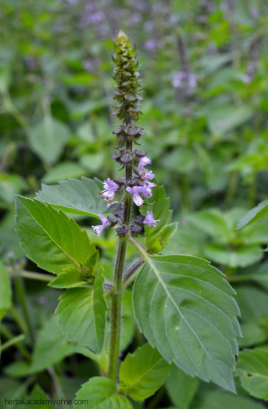
Botanical Characteristics
Botanical Name: Ocimum sanctum (syn. O. tenuiflorum; O. gratissimum; O. africanum)
Common Name: Tulsi, Holy Basil
Family: Lamiaceae (mint)
Ayurvedic/TCM name: Ayurvedic name: Kapoor tulsi; TCM name: Luo le (2)
Parts used: Leaves, flowers (1), Seeds (2)
Botanical description: Green leaves, small purple flowers along a raceme on top of plant (3), fruity fragrance, compact growth, square stem, opposite leaves. Hairs on stem, bottom of leaves, and on flower raceme. Leaves are serrated.
Contraindications: Avoid using during pregnancy, may have an antifertility effect on men and women. May speed up elimination of some medications. Always consult a health practitioner before using. (2) May be blood thinning and should not be taken with blood-thinning pharmaceuticals. (3)
The Properties of Tulsi
Energetics: Warming, Drying, Relaxant (15)
Taste: Pungent, Sweet (1, 14)
Plant Properties: Adaptogen, Anti-microbial, Aromatic digestive, Relaxing nervine, Cardiovascular tonic, Neuroprotective, Antioxidant, Immunomodulator, Analgesic (1) Stimulant Expectorant, Stimulant and Relaxant Diaphoretic (15)
Preparations: Tea, Decoction, Tincture, Fresh juice, Poultice, Powder, Mouthwash, or Infused into Ghee or Honey.
The Many Benefits of Tulsi
Adaptogenic properties:
One of Tulsi’s most well-known roles is as an adaptogen, an herb that helps the body respond more effectively to stress. Tulsi interacts with the hypothalamic-pituitary-adrenal (HPA) axis, helping to regulate the stress response and reduce cortisol levels. (1,2, 15) Taken daily, it can ease symptoms of excessive stress, anxiety, insomnia, and mild depression. (1) Tulsi is also considered a relaxing nervine, supporting the nervous system gently but effectively over time. (1)
Cognitive Support:
Tulsi is considered a cerebral stimulant, it has been used to reduce mental fog, support focus, and enhance clarity of thought. It’s particularly helpful for people with ADD or ADHD, menopausal individuals experiencing brain fog, or those recovering from head trauma. (1)
Immunomodulator:
One of Tulsi’s strongest suits is its powerful immunomodulatory effect. It can be used both preventatively and acutely to help the body fight off illness. Tulsi strengthens the immune system while also acting directly against a wide range of pathogens — including viruses, bacteria, and fungi. It has even been used for managing herpes simplex virus (HSV), ringworm, and eczema, topically. (9) Tulsi has been shown to be effective against cancers. (9)
Support for Colds, Flus, and Allergies
Tulsi is commonly used to address viral infections, including the common cold and flu (1; 3). Its immune-enhancing and antimicrobial actions help the body respond quickly and effectively to infection. (1) Stuck mucus is cleared from the throat and sinuses due to the expectorant actions of Tulsi. (15) Because of its diaphoretic, antiseptic and expectorant properties, Tulsi promotes sweating during fevers that are difficult to lower and allows heat to leave your body through your pores. (15)
Cardiovascular Health:
Tulsi is considered a cardiovascular tonic, supporting heart health through a number of mechanisms (3). Clinical studies have shown that Tulsi can help lower cholesterol and triglyceride levels while improving lipid profiles and insulin sensitivity (8; 12). This makes it particularly beneficial for those managing high blood pressure, high blood sugar, or metabolic syndrome (8).
Digestive Support:
Tulsi is particularly useful for stagnant digestion associated with bloating, gas, decreased appetite, and nausea. (1)
Oral Health:
Tulsi has also shown promise in the realm of oral care. Mouthwashes made with holy basil have been proven effective in reducing plaque and gingivitis. (7, 11) In fact, clinical studies have found Tulsi mouthwash to be comparable to chlorhexidine, a commonly used antimicrobial rinse, but without the harsh side effects. (11)
Other uses:
Research also points to Tulsi having radioprotective qualities, meaning it may help shield the body from the harmful effects of radiation. (2) Additionally, a cold infusion of the flowering tops of the plant acts as a demulcent, providing a soothing, moistening action that calms irritated tissues. This can be especially useful in cases of ulcers or general dryness and inflammation. (1) The seeds are also demulcent and can be used as a way to soothe irritable urinary tract conditions (15)
Now that you know all about Holy Basil, Tulsi, let's jump in to Week 1 of our Herb Challenge!! Click here to learn how to make a Holy Basil Tincture.
Citations
De La Foret, R. (2023, September 5). Health benefits of Tulsi. HerbalRemediesAdvice.org. https://www.herbalremediesadvice.org/health-benefits-of-tulsi.html
Winston, D., & Maimes, S. (2007). Adaptogens: Herbs for strength, stamina, and stress relief (p. 170). Healing Arts Press.
Florida School of Holistic Living. (2019, May 28). June plant of the month: Tulsi. https://www.holisticlivingschool.org/2019/05/28/june-plant-of-the-month-tulsi/
Engels, L. (2023, July 12). Holy basil plant profile. The Spruce. https://www.thespruce.com/holy-basil-plant-profile-5184884#:~:text=Holy%20basil's%20native%20range%20is,it%20indoors%20in%20any%20zone
Metzger, J. (2016, September 30). Creating a local materia medica: Holy basil. The Herbal Academy. https://theherbalacademy.com/blog/creating-local-materia-medica-holy-basil/
Dharsono, H. D. A., Putri, S. A., Kurnia, D., Dudi, D., & Satari, M. H. (2022). Ocimum Species: A Review on Chemical Constituents and Antibacterial Activity. Molecules (Basel, Switzerland), 27(19), 6350. https://doi.org/10.3390/molecules27196350
Gupta, D., Bhaskar, D. J., Gupta, R. K., Karim, B., Jain, A., Singh, R., & Karim, W. (2014). A randomized controlled clinical trial of Ocimum sanctum and chlorhexidine mouthwash on dental plaque and gingival inflammation. Journal of Ayurveda and integrative medicine, 5(2), 109–116. https://doi.org/10.4103/0975-9476.131727
Satapathy, S., Das, N., Bandyopadhyay, D., Mahapatra, S. C., Sahu, D. S., & Meda, M. (2017). Effect of Tulsi (Ocimum sanctum Linn.) Supplementation on Metabolic Parameters and Liver Enzymes in Young Overweight and Obese Subjects. Indian journal of clinical biochemistry : IJCB, 32(3), 357–363. https://doi.org/10.1007/s12291-016-0615-4
Kwak, T. K., Sohn, E. J., Kim, S., Won, G., Choi, J. U., Jeong, K., Jeong, M., Kwon, O. S., & Kim, S. H. (2014). Inhibitory effect of ethanol extract of Ocimum sanctum on osteopontin mediated metastasis of NCI-H460 non-small cell lung cancer cells. BMC complementary and alternative medicine, 14, 419. https://doi.org/10.1186/1472-6882-14-419
Sow Right Seeds. (n.d.). Tulsi, the Incomparable One: How to grow and care for holy basil plants. Retrieved October 7, 2025, from https://sowrightseeds.com/blogs/planters-library/how-to-grow-holy-basil-benefits-tea#:~:text=hours%20of%20sunlight.-,Harvesting%20Holy%20Basil,benefit%20of%20attracting%20honey%20bees
Hosamane, M., Acharya, A. B., Vij, C., Trivedi, D., Setty, S. B., & Thakur, S. L. (2014). Evaluation of holy basil mouthwash as an adjunctive plaque control agent in a four day plaque regrowth model. Journal of clinical and experimental dentistry, 6(5), e491–e496. https://doi.org/10.4317/jced.51479
Mondal, Shankar, Saurabh Varma, Vishwa Deepak Bamola, Satya Narayan Naik, Bijay Ranjan Mirdha, Madan Mohan Padhi, Nalin Mehta, and Sushil Chandra Mahapatra. “Double-Blinded Randomized Controlled Trial for Immunomodulatory Effects of Tulsi (Ocimum Sanctum Linn.) Leaf Extract on Healthy Volunteers.” Journal of Ethnopharmacology 136, no. 3 (July 14, 2011): 452–56. https://doi.org/10.1016/j.jep.2011.05.012.
Shutes, J. (2014). Distilling your own hydrosols. The School of Aromatic Studies. Retrieved from https://aromaticstudies.com/distilling-your-own-hydrosols/
Hayes, R. (n.d.). Tulsi (Ocimum sanctum). In HerbRally Monographs. Retrieved October 13, 2025, from https://www.herbrally.com/monographs/tulsi-rh
Popham, S. (2025, July 9). Holy Basil: The Sacred Herb of Ayurveda. Evolutionary Herbalism. Retrieved July 10, 2025, from https://www.evolutionaryherbalism.com/2025/07/09/holy-basil/
LearningHerbs. (n.d.). Herbal Basics — LearningHerbs. Retrieved October 13, 2025, from https://www.learningherbs.com/products/herbal-basics/categories/2154887519/posts/2175703112


Comments